
Highlights
No-invasive, real-time monitoring
Detects changes in heart rate, respiration, and body/face motion instantly without cables, electrodes, or skin contact.
AI-based multimodal sensing integration
Fusion of optical (RGB/IR), mechanical (laser/LiDAR), and AI-based data for robust physiological and non physiological parameters monitoring.
Integration compatible with standard hardware
Intuitive GUI designed for simple integration into existing infrastructures and adaptability to robotic platforms.
Keywords
Contactless monitoring, remote PPG, LiDAR sensing, physiological estimation, Health technology, Human–robot interaction, Safety
ML-based Contactless Monitoring System for Health and Safety
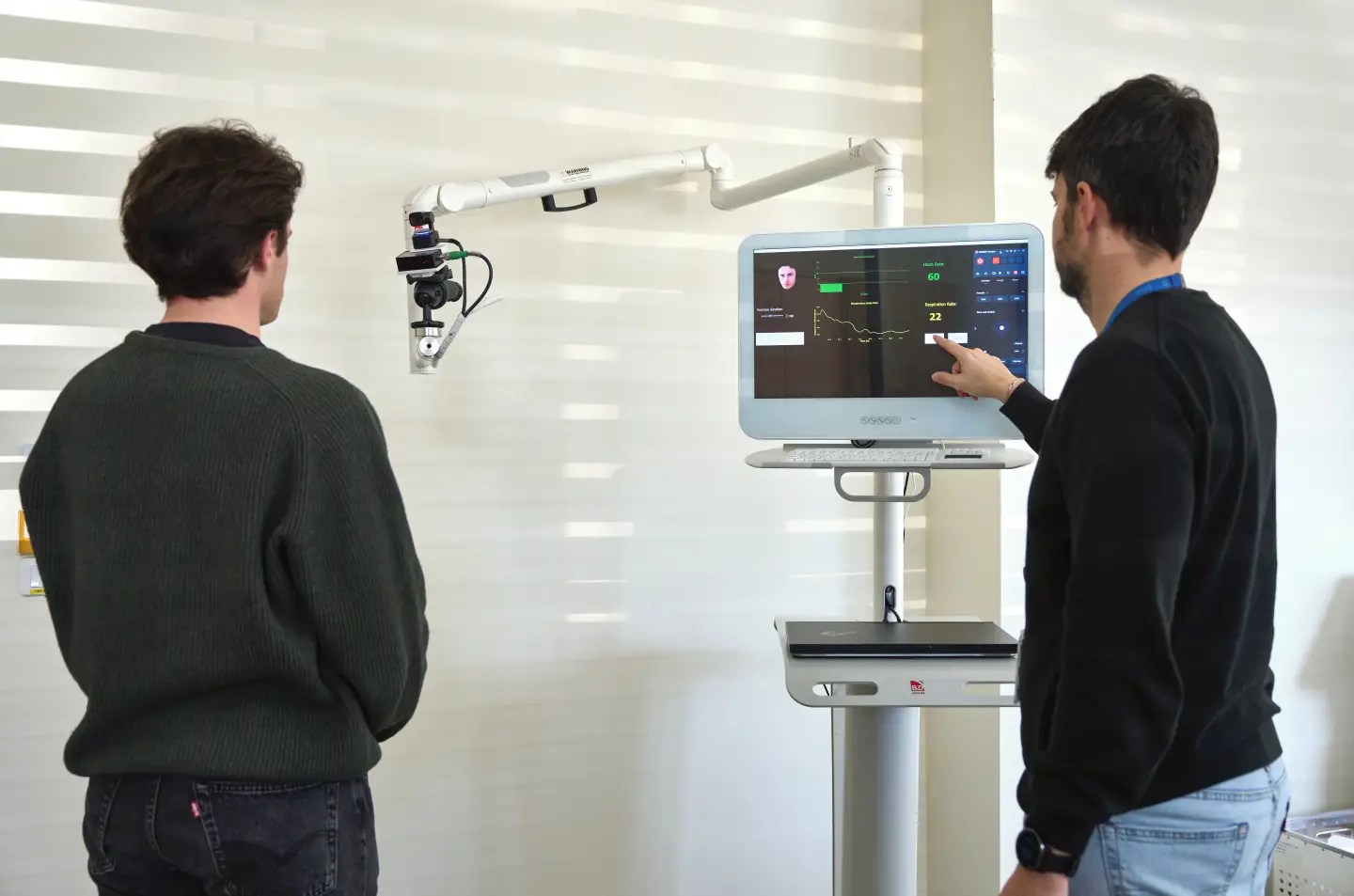
VitaSense AI is a Machine Learning-based contactless monitoring technology enabling the estimation of physiological and non-physiological parameters (heart rate, respiration rate, facial motion, and body movements) using cameras and lasers without physical contact, electrodes, or wearable sensors, offering a hygienic, reusable, and real-time solution for monitoring people’s physiological and behavioural states.
Originally developed at CERN for robotic search and rescue operations, VitaSense AI has been adapted for medical and healthcare applications in collaboration with hospitals and academic partners. The system leverages multimodal sensing to extract physiological parameters in real time, even under challenging conditions such as variable lighting, motion, or partial occlusion, providing a non-invasive, hygienic, and reusable monitoring solution that enhances both patient comfort and operator safety.
By integrating physiological signals for an individual with motion and other non-physiological signals for multiple people, the system provides a comprehensive assessment of a person’s or group’s state. The software is designed to work with readily available cameras and devices, making it immediately deployable across a wide range of scenarios such as search and rescue missions, offshore and industrial safety monitoring, telemedicine, (home) healthcare, operator fatigue and stress assessment, as well as physical rehabilitation and mobility tracking.
Clinical validation studies in geriatric wards and for predictive monitoring during paediatric anaesthesia are currently ongoing.
Advantages
Autonomous and unobtrusive monitoring
Minimizes measurement error (<2 bpm) compared to existing solutions, guaranteeing consistent data quality in dynamic environments
Operational under challenging conditions
Functions in radioactive, confined, or high temperature industrial areas, minimizing the risk of cross-contamination.
Continuous real-time monitoring
Detects physiological changes instantly, supporting early interventions or safety responses in both medical and industrial scenarios.
Portable, modular, and energy-efficient
Easily deployable, integrated on various platforms, or adapted for remote or long duration operations.
Validated, worker-centric design
Unobtrusive monitoring improves comfort, compliance, and long-term usability.
Applications
Contactless Monitoring in:
- Health & Wellbeing
- Remote patient and elderly-care monitoring
- Fatigue, stress, and wellness tracking
- Telemedicine and assisted-living support
- Safety & Industrial Operations
- Worker health and hazard detection in industrial, offshore, and confined environments
- Predictive safety and emergency response monitoring
- Robotics & Mobility
- Human–robot interaction and cooperative robotics
- Search-and-rescue operations and autonomous systems
- Rehabilitation and motion analysis
The versatility of the technology enables its adaptation across a wide range of domains, from clinical care to robotics, industrial applications, and emergency scenarios.
Publications
CITTADINI, ROBERTO, ET AL. “ROBOT-AIDED CONTACTLESS MONITORING OF WORKERS’ CARDIAC ACTIVITY IN HAZARDOUS ENVIRONMENT.” IEEE ACCESS 10 (2022): 133427 133438. (LINK)
CITTADINI, ROBERTO, ET AL. “CONTACTLESS RESPIRATION RATE MONITORING AND HUMAN BODY POSE DETECTION FOR SEARCH AND RESCUE ROBOTS.” 10TH IEEE RAS/EMBS INTERNATIONAL CONFERENCE FOR BIOMEDICAL ROBOTICS AND BIOMECHATRONICS (BIOROB). IEEE, 2024. (LINK)